
The commercial decision
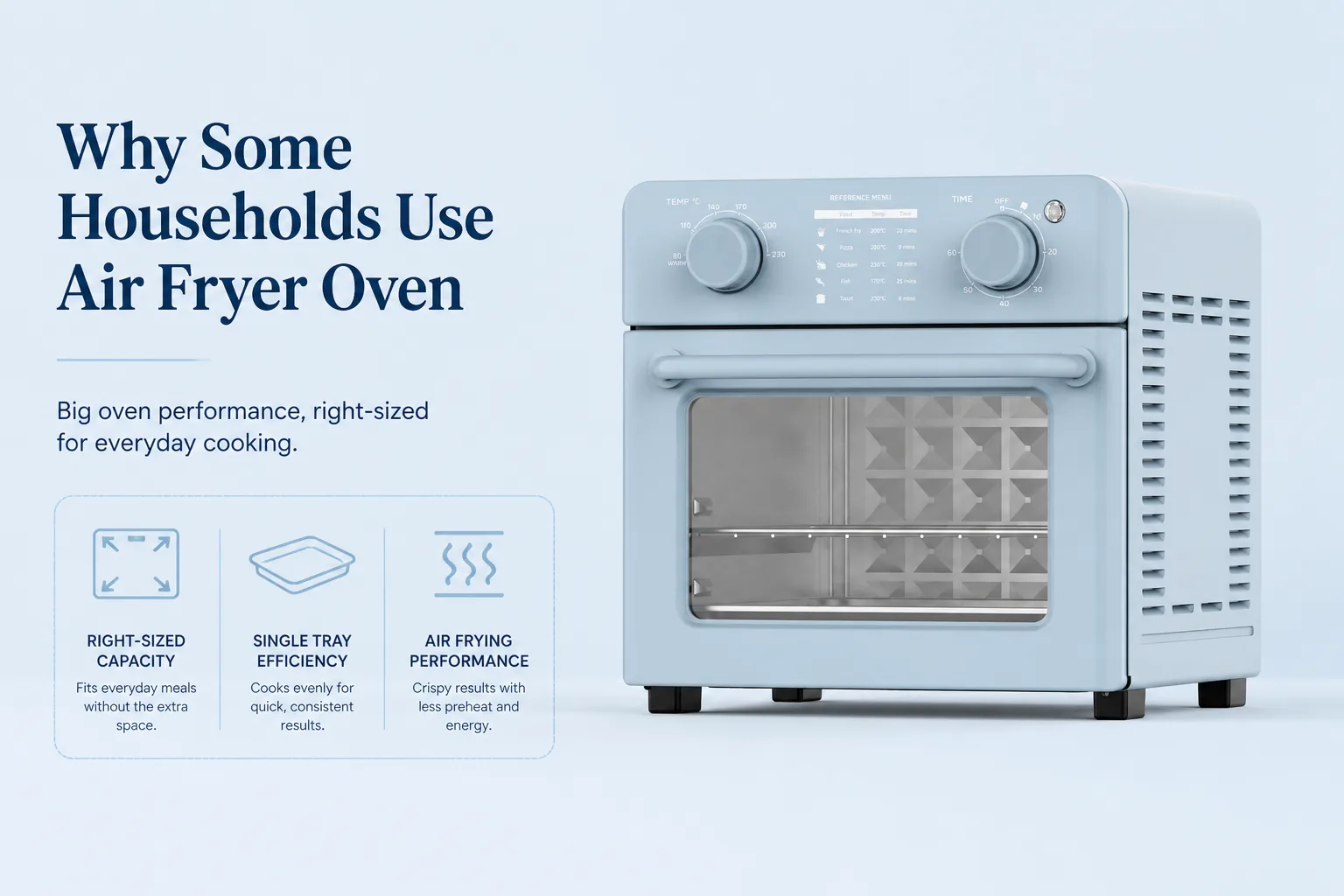
The credible story is substitution by occasion, not the disappearance of traditional ovens. Small meals, frozen foods and reheating can favour a compact cavity; large trays, multiple dishes and installed cooking can favour a full-size oven. Assortment decisions should reflect that split.
What the evidence can support
A worked energy example shows why the baseline matters. A 1.8 kW countertop unit running at full input for 20 minutes would use 0.60 kWh; a 3.0 kW oven at full input for 50 minutes would use 2.50 kWh. Real thermostatic appliances cycle below full input, so both figures are upper-bound arithmetic examples, not product claims.
A repeatable way to compare suppliers
Measure energy with a complete cycle and identical food endpoint. Separate preheat, active cooking and standby where possible. Add hands-on steps, cleaning time, noise and tray capacity, then repeat on production-representative units. A faster result that is uneven or needs two batches is not necessarily more convenient.
Cost and launch consequences
Use the findings to identify occasions that can be demonstrated truthfully on packaging and product pages. A narrow evidence-backed promise is more durable than 'replaces your oven'. It also reduces returns from buyers whose capacity or cooking expectations were never addressed.
Boundaries on the claim
Do not convert the arithmetic example above into advertising. Verify actual duty cycle, voltage, load and endpoint for the products being compared and check local rules before publishing an energy-saving claim.
Sources and scope
The references below define measurement, safety, quality or regulatory context. They do not replace product-specific testing or legal review for the final construction and market. Accessed 7 August 2026.
- IEC 60350-1, electric cooking ranges, ovens, steam ovens and grills - methods for measuring performance: https://webstore.iec.ch/
- U.S. eCFR, 10 CFR Part 430, energy conservation program for consumer products: https://www.ecfr.gov/current/title-10/chapter-II/subchapter-D/part-430
- European Union, General Product Safety Regulation (EU) 2023/988: https://eur-lex.europa.eu/eli/reg/2023/988/oj