
The commercial decision
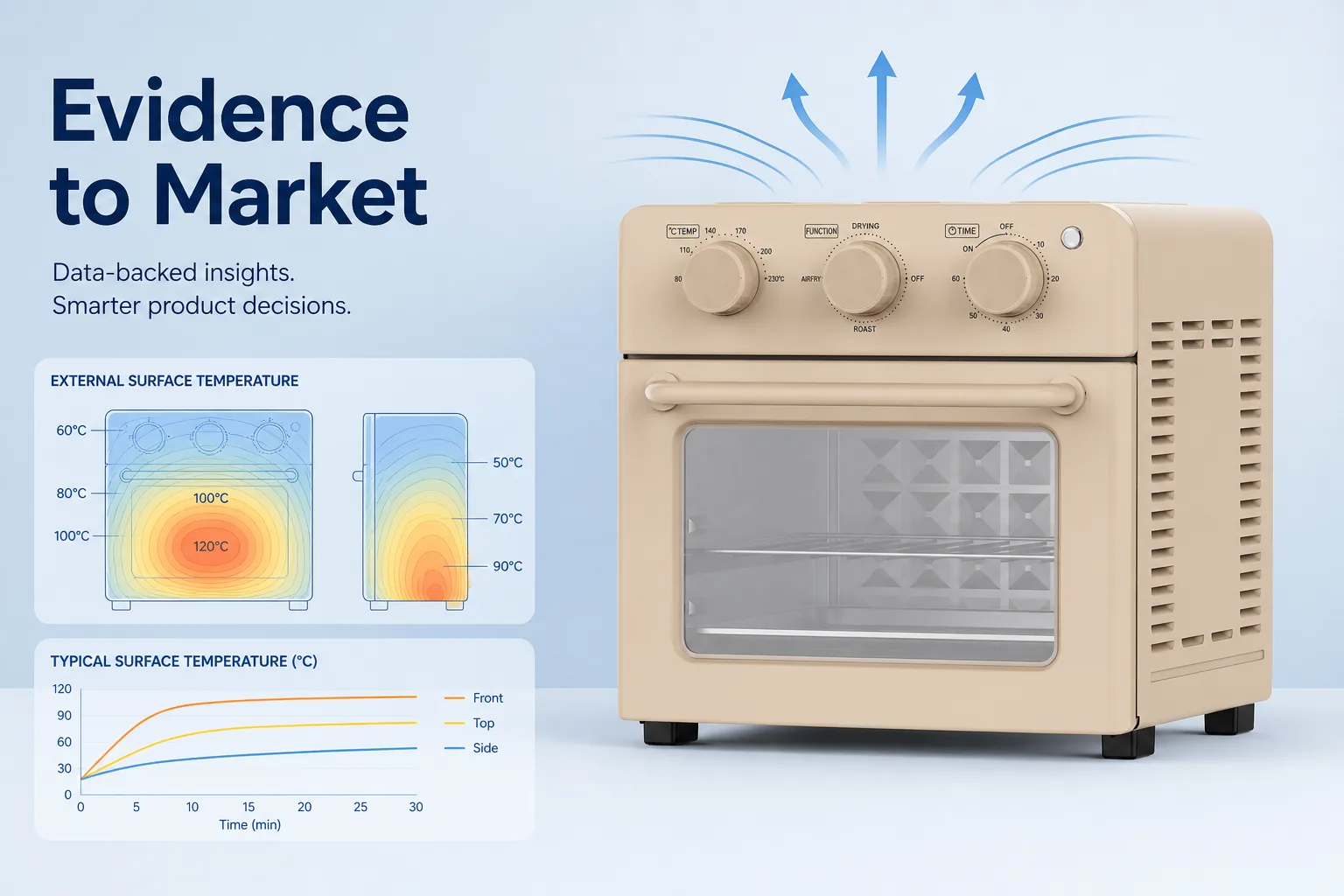
A cool-looking enclosure is not evidence of low surface temperature. Heat reaches the exterior by conduction through fasteners and frames, radiation from the cavity and glass, and hot air escaping near vents. The design must manage all three paths without blocking required airflow.
What the evidence can support
Useful controls include air gaps, reflective shields, insulation, thermal breaks at handles, controlled vent direction and separation between hot metal and plastic. Each can move heat elsewhere, so a local improvement must be checked against wiring, electronics, wall clearance and food performance. Surface limits also depend on material, location, accessibility and the applicable standard; one temperature number does not fit every surface.
A repeatable way to compare suppliers
Map the top, sides, rear, controls, handle and door perimeter at nominal and high supply conditions using production-representative units. Record ambient temperature, operating mode, load, dwell time, probe or sensor attachment and the hottest point, not an average selected after the run. Repeat after thermal cycling and assembly variation.
Cost and launch consequences
Temperature mapping affects claim language, packaging warnings, handle materials, kitchen clearances and return risk. Write critical insulation, shield and fastener details into the control plan. An operator omitting a small foil shield can change the result even when final appearance is identical.
Boundaries on the claim
Avoid terms such as 'safe to touch' or 'cool touch' without a defined surface, method and market requirement. Passing an accessible-surface test does not mean the whole appliance remains comfortable to touch during operation.
Sources and scope
The references below define measurement, safety, quality or regulatory context. They do not replace product-specific testing or legal review for the final construction and market. Accessed 7 August 2026.
- IEC 60335-1 and IEC 60335-2-9, household appliance safety and portable cooking appliances: https://webstore.iec.ch/
- European Union, Low Voltage Directive 2014/35/EU: https://eur-lex.europa.eu/eli/dir/2014/35/oj
- European Union, General Product Safety Regulation (EU) 2023/988: https://eur-lex.europa.eu/eli/reg/2023/988/oj