
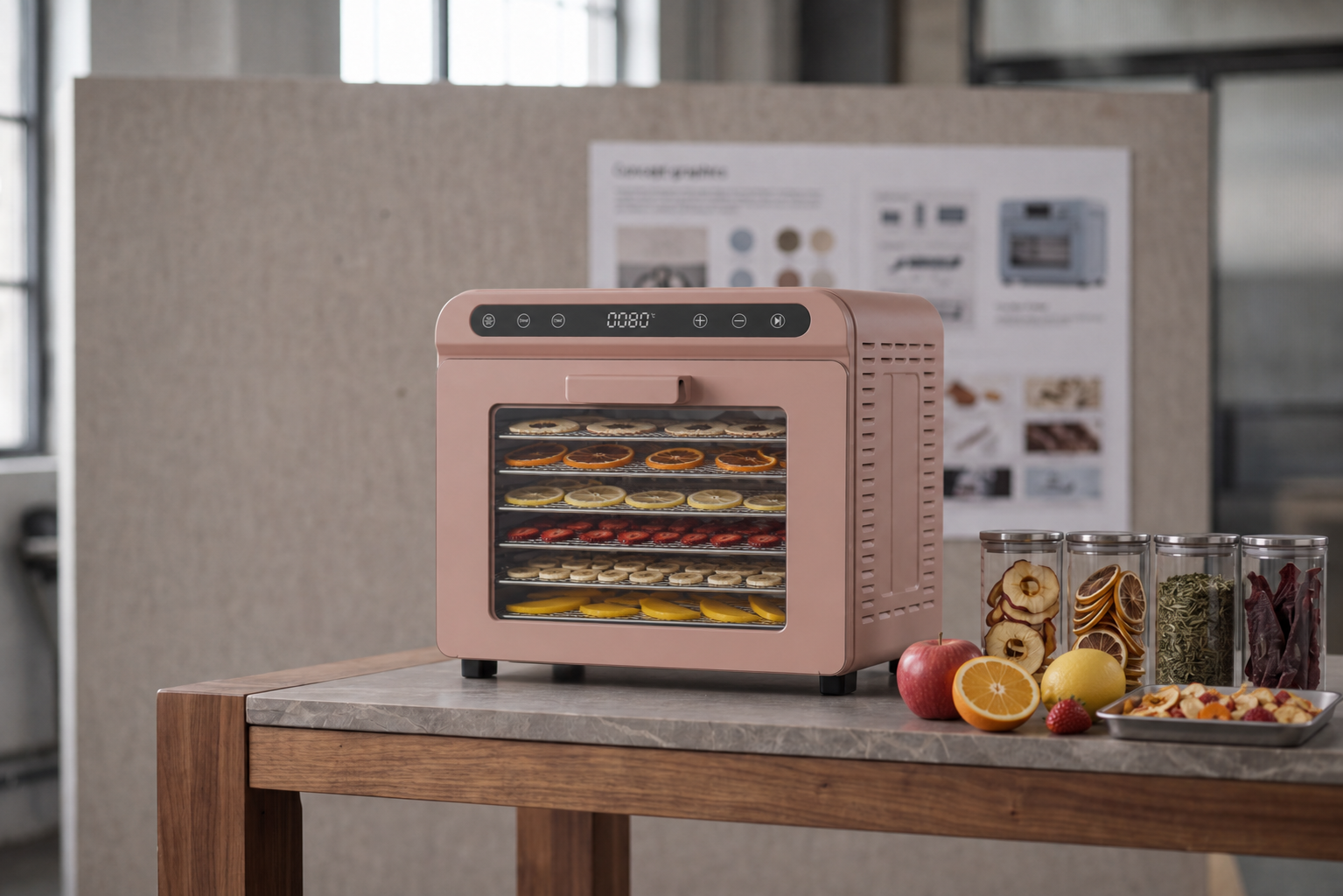
Add a category, not just a machine
A food dehydrator can widen an appliance range because it serves a different use case from an air fryer or toaster oven: preserving ingredients, making shelf-stable snacks and preparing small-batch ingredients. The business case should start with the customer and channel, then move to the machine.
The demand case is practical
Food preservation is not a fad claim. In its Food Waste Index Report 2024, the United Nations Environment Programme estimated that 1.05 billion tonnes of food were wasted in 2022 across households, food service and retail. A dehydrator will not solve that problem on its own, but it gives households and small producers one way to use surplus fruit, vegetables and herbs.
Define the product before the lifestyle copy
Buyers should specify tray count, usable tray area, temperature range, timer behaviour, airflow path, noise expectations, cleaning method and food-contact materials. These are product requirements, not interchangeable marketing phrases. A cabinet dehydrator and a compact countertop model may share a name while offering very different loading and drying results.
Safety and user guidance matter
The National Center for Home Food Preservation explains that drying removes enough moisture to slow the growth of bacteria, yeasts and molds, but it also stresses preparation and storage. Meat snacks need extra care: the U.S. Department of Agriculture publishes separate jerky safety guidance. A private-label program should provide tested instructions for the intended recipes and market rather than implying that a temperature dial alone guarantees safety.
What OEM customization should cover
Useful customization may include tray material and spacing, front-panel language, control logic, preset programs, colour, packaging and accessory configuration. Ask the factory to show which changes are cosmetic and which affect airflow, heat distribution, electrical loading or validation. A new tray geometry can change capacity claims and drying time; it deserves a new test record.
A sensible partner checklist
Look for a partner that can provide a sample with the final tray set, document the temperature and airflow test conditions, identify food-contact materials and explain change control. Compare the total program: sample rounds, compliance work, packaging, spare parts, inspection and after-sales support matter as much as the ex-works price.
Sources and notes
- UNEP, Food Waste Index Report 2024: https://www.unep.org/resources/publication/food-waste-index-report-2024
- National Center for Home Food Preservation, Drying: https://nchfp.uga.edu/how/dry/
- USDA FSIS, Safe Preparation of Meat and Poultry Jerky: https://www.fsis.usda.gov/food-safety/safe-food-handling-and-preparation/meat/jerky
Drying temperatures, capacities and lead times are model-specific. Validate them on the finished configuration.