
1. Decide what the sample must prove
An oven sample should answer the important questions in your purchasing brief. It cannot prove the quality of an entire future production run on its own. Begin by separating three decisions: whether the design fits your customers, whether the sample performs as expected, and whether the supplier can reproduce the approved version. Keep a written record for each decision instead of ending a review with a general impression that the oven "looks good".
This guide describes a buyer's comparison process, not a replacement for laboratory safety testing or an official test standard. Agree on the protocol with the supplier before testing so a disappointing result can be investigated without arguing about what was done.
2. Identify each sample and its condition
Give each unit a unique reference. Photograph the rating plate, controls, accessories and packaging, and record the model, voltage, frequency, software version where relevant and date received. Ask whether it is an engineering prototype, a production-intent sample or a unit taken from normal production. Those descriptions should not be used interchangeably.
Check for shipping damage before operating it. Follow the supplied installation and first-use instructions, including any specified initial heating procedure. Keep the sample in a suitable test area with the required clearances. If wiring, a plug or the enclosure appears damaged, stop and ask a qualified person to assess it.
3. Keep the comparison conditions consistent
Use the same recipe, food batch, starting temperature, mass, tray type, rack position and loading pattern for each oven. Record the room conditions and supply configuration. Follow the same preheating rule and use the same definition of the cooking endpoint. Changing several of these inputs can make one model appear better for reasons unrelated to its design.
For a practical internal exercise, you might repeat a key recipe three times and compare all results. This is an example of a buyer-defined comparison, not a statistically sufficient sampling plan or a certification requirement. Agree how many units and repetitions are needed for the decision's risk and the claims you intend to make.
4. Check what your instruments can tell you
Use temperature and energy instruments suitable for the conditions and have qualified personnel arrange the measurement safely. Record the instrument identity, relevant calibration information and measurement uncertainty. NIST explains that calibration traceability depends on documented comparisons and their uncertainties. [1] A display with many decimal places does not, by itself, establish measurement accuracy.
Do not compare a temporary reading at one point in the cavity with the control display and immediately declare the oven defective. Sensor location, radiation from heating elements, response time and the point in the heating cycle affect the result. Write down the measurement arrangement so the same setup can be repeated.
5. Separate three temperature questions
Temperature stability asks how a defined measurement point changes over time once the oven is operating under the agreed conditions. Spatial variation asks how readings differ between positions. Recovery asks what happens after a specified event, such as opening the door and adding a load. These are different questions and need clearly described measurements.
Avoid presenting an empty-cavity test as proof of performance with several loaded trays. If customers will use more than one rack, include that arrangement in the agreed test. Do not invent a universal temperature tolerance for every oven; establish limits that match the product promise, the method and the measurement uncertainty.
6. Use food tests for the questions customers notice
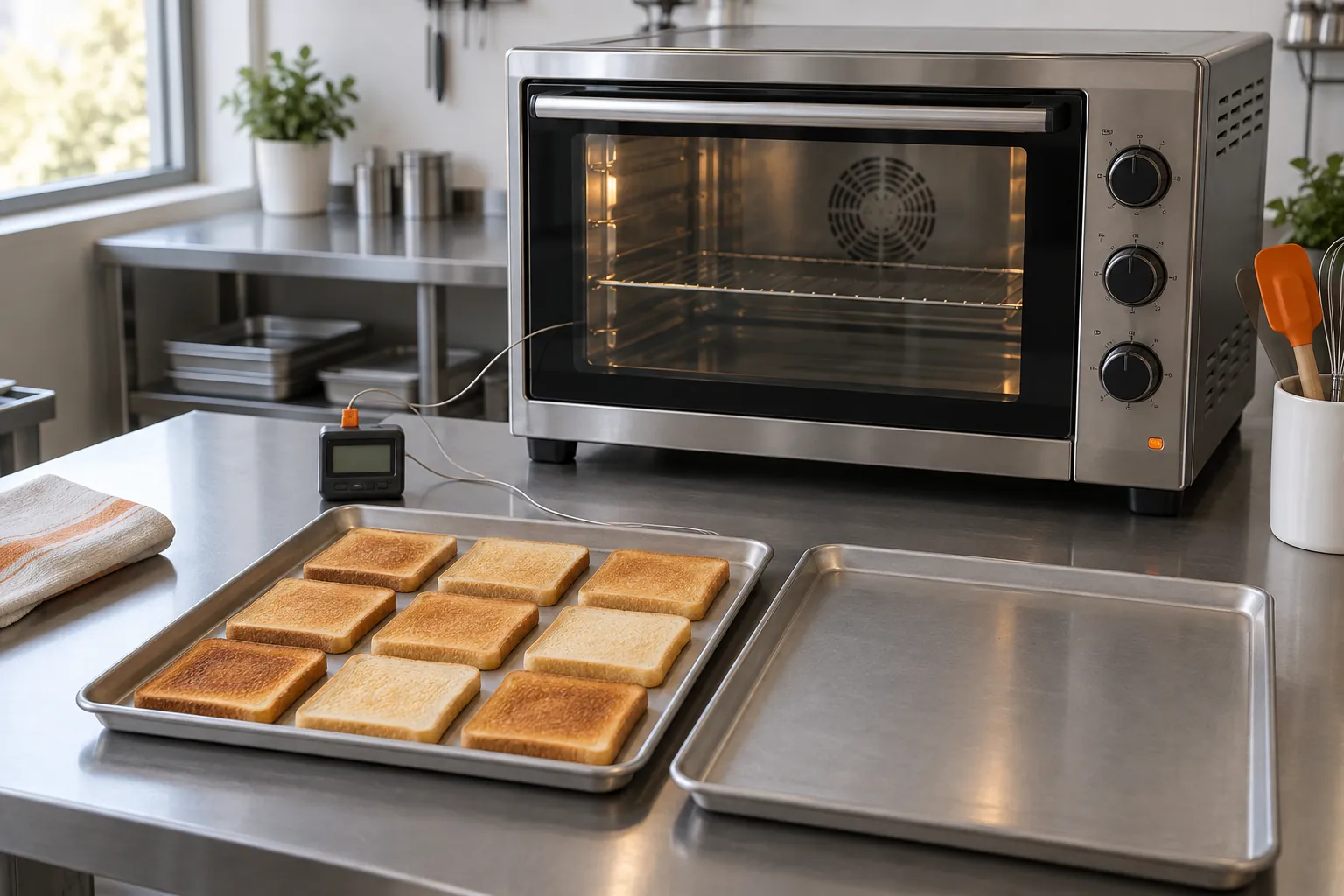
Simple food tests can reveal practical differences that a specification sheet misses. Use a consistent arrangement of toast pieces to observe browning patterns, or compare a defined baking recipe when that task matters to the range. Photograph results under the same lighting and record the time, position and settings. Do not treat a toast pattern as a calibrated temperature map.
Include one ordinary user task and one demanding but intended-use task. Note whether the manual requires tray rotation. If rotation is allowed in one comparison and omitted in another, record that difference explicitly. The goal is a repeatable, acceptable outcome, not the most flattering photograph from a single run.
7. Compare energy at the same cooking endpoint
Rated watts describe an input rating; a complete cycle involves heating time and cycling behaviour. Measure energy for the same load and finish using a suitable setup. Separate preheating, cooking and any waiting period so you understand where the difference comes from. State the test boundary when reporting the result.
As an arithmetic example, 0.50 kWh per accepted batch at a tariff of 0.20 currency units per kWh costs 0.10 currency units in electricity. These are hypothetical numbers, not measured performance or a market tariff. If one oven needs an additional batch to deliver the required quantity, include it rather than comparing only the first cycle.
8. Ask an unfamiliar user to operate the oven
Give the user the draft instructions and an ordinary cooking task. Observe whether they can choose a mode, set the time and temperature, recognise that heating has started and stop the programme. Ask them to explain confusing symbols in their own words. Record misunderstandings without coaching them through every step.
After the unit has cooled and is disconnected as instructed, review cleaning and accessory removal. Check whether the crumb tray is accessible and whether grease collects in awkward locations. Assess the handling experience using the instructions and suitable protection, rather than deliberately touching hot surfaces to judge safety.
9. Keep safety testing separate from buyer demonstrations
Electrical, abnormal-operation and other hazardous tests belong with competent specialists and appropriate facilities. A buyer's cooking demonstration cannot establish electrical safety, food-contact compliance or suitability for professional use. The IEC scope for portable household cooking appliances helps illustrate why the intended use and product category matter. [2]
Request the applicable report scope for the exact model and configuration, then ask the laboratory or certification body to clarify uncertainties. Do not bypass protective devices or modify the appliance to "see what happens". Escalate suspected safety problems and pause approval until they are resolved.
10. Score evidence rather than impressions
Create a scorecard with performance, usability, cleaning, documentation, serviceability and commercial fit. Set pass-or-fail gates for essential requirements before adding weighted scores. A high score for appearance must not compensate for an unresolved essential requirement. Write down why a result passed, failed or needs another test.
For an illustrative weighting, cooking could receive 35%, usability 20%, cleaning 15%, serviceability 15% and commercial fit 15%. This is a discussion tool, not an industry standard. Adjust the weights to your customers and keep the mandatory gates outside the weighted average. Attach observations and photographs to each important conclusion.
11. Close the loop before approving production
Issue one consolidated correction list with the sample reference, observation, requested action, responsible person and deadline. When a change affects a component, control programme, accessory or instruction, agree which tests must be repeated. Do not assume that a revised photograph proves the underlying problem has been corrected.
Once the agreed requirements are met, identify the approved reference sample and freeze its specification. Record what the approval covers and what remains open. Link the drawings, component list, artwork, packaging and inspection plan to that revision. This turns a useful sample review into a clear production handover, while leaving room for a separate assessment of manufacturing consistency.
Sources and scope
These references support general context. Product requirements, compliance and performance must be confirmed for the exact model and destination market.