
The commercial decision
Consumers do not replace a built-in oven because a category headline tells them to. They choose the appliance that handles a frequent job with less setup, less unused cavity and a simpler cleanup path. For a retailer, the question is which jobs a countertop model completes well enough to earn permanent counter space.
What the evidence can support
A smaller heated cavity generally contains less air and metal mass than a full-size oven, but energy and time depend on set temperature, insulation, controls, load and preheat practice. Use watt-hours from a plug-in power analyser and a defined food result. Rated watts describe maximum input, not energy consumed by a complete cooking cycle.
A repeatable way to compare suppliers
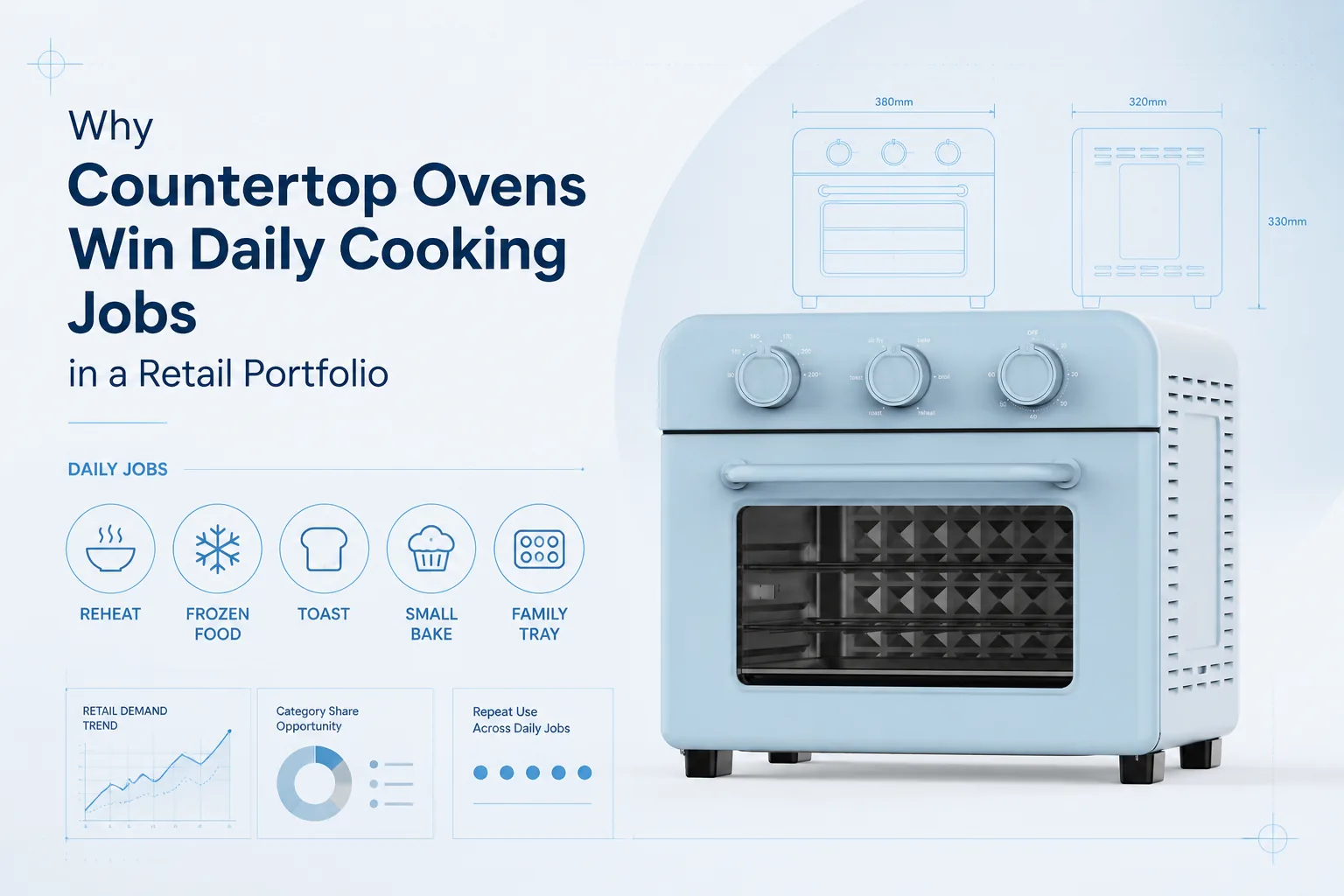
Test five repeatable jobs that match the channel: reheating a portion, frozen food, toast, a small bake and a family tray. Record active time, elapsed time, watt-hours, accessory changes, cleaning steps and result consistency. Interview test users after they operate the production interface without coaching; a laboratory cook should not stand in for the intended customer.
Cost and launch consequences
The useful retail claim is specific: the model can replace a named step in a named meal. This supports assortment, packaging and demonstration content. It also exposes gaps, such as a small tray, noisy fan or control sequence that makes the appliance less convenient than the product it is supposed to complement.
Boundaries on the claim
Do not publish 'uses 50% less energy' or 'cooks twice as fast' from rated power or an empty preheat test. Select a baseline appliance, disclose the food load and endpoint, and retain the raw cycle data. The result is valid for that comparison, not every oven and every recipe.
Sources and scope
The references below define measurement, safety, quality or regulatory context. They do not replace product-specific testing or legal review for the final construction and market. Accessed 7 August 2026.
- IEC 60350-1, electric cooking ranges, ovens, steam ovens and grills - methods for measuring performance: https://webstore.iec.ch/
- U.S. eCFR, 10 CFR Part 430, energy conservation program for consumer products: https://www.ecfr.gov/current/title-10/chapter-II/subchapter-D/part-430
- European Union, General Product Safety Regulation (EU) 2023/988: https://eur-lex.europa.eu/eli/reg/2023/988/oj