
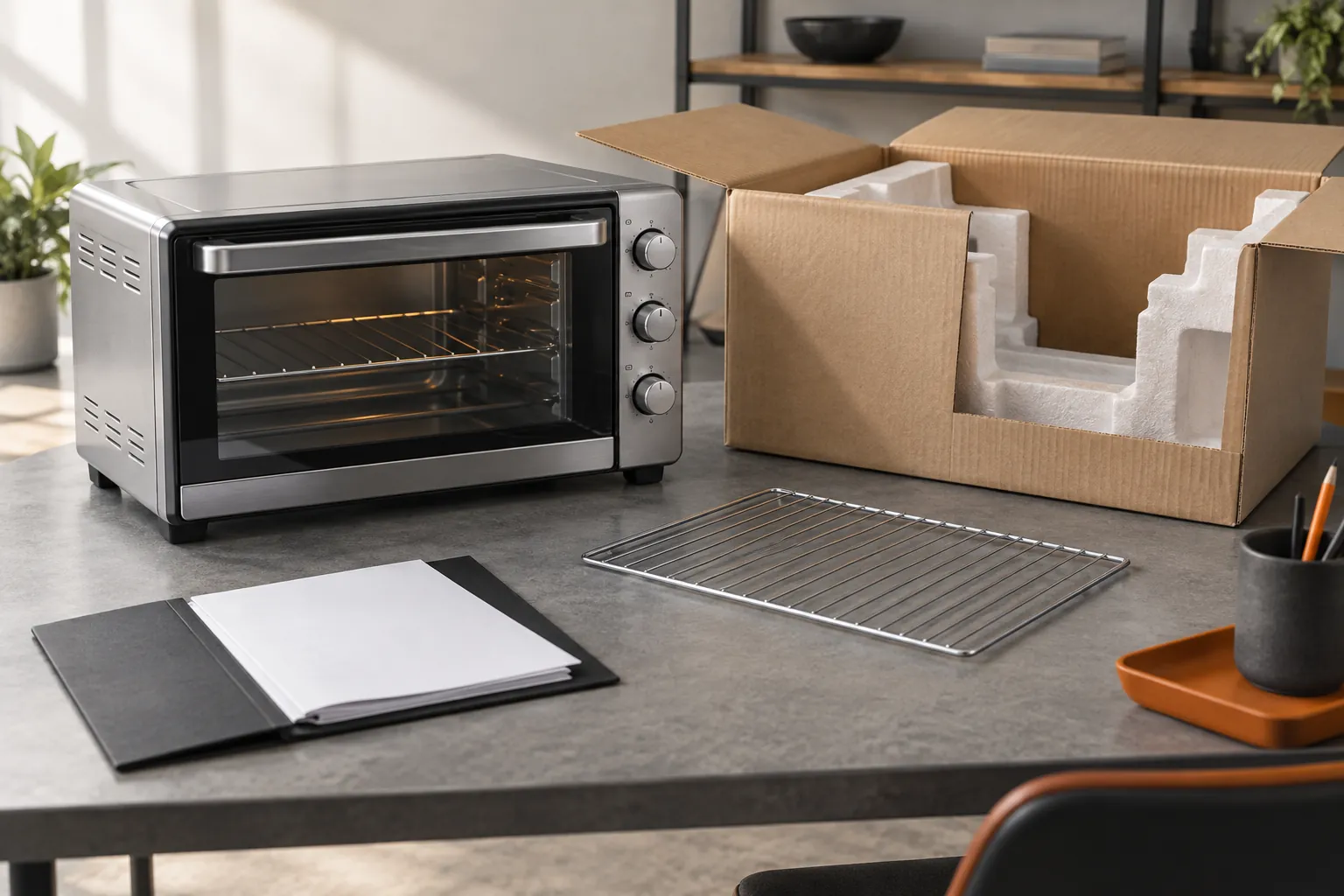
1. Make every quotation answer the same question
Choosing an oven OEM supplier becomes difficult when three quotations describe three different products. Before requesting prices, issue one revision-controlled brief covering intended use, electrical version, usable capacity, cooking functions, controls, accessories, finish, packaging and documentation. State which details are fixed and which are open for recommendation.
Ask each supplier to return a compliance matrix against that brief: included, excluded, optional or requiring development. A short explanation beside an exception is more valuable than a blanket promise. Keep the matrix with the quotation so that a later price revision does not silently change the product you thought you were buying.
2. Separate a standard platform from development work
A catalogue platform with a different colour may involve a different project from a new control board, cavity, door or connected feature. Ask which parts of the offered model already exist and which must be developed. Identify tooling, engineering, artwork, testing and sample costs separately, including ownership and the conditions for reuse.
Be precise about quantity. Request scenarios for the expected first order and a realistic later volume, without treating a forecast as a purchase commitment. Clarify whether a minimum applies to the full model, one colour, printed packaging or an accessory. A headline MOQ can be misleading when different components have different purchasing constraints.
3. Match documents to the offered oven
Build a document list around the destination market and exact configuration. Include the model identification, electrical rating, responsible manufacturer, applicable test scope, instructions and any required declarations. Ask a qualified laboratory or compliance specialist to identify what applies; a buyer's checklist is not a complete legal assessment.
For the EU, CE marking represents the manufacturer's declaration of conformity with applicable requirements, not an approval awarded by an EU authority. [1] Therefore, a photograph of the mark should begin a document review rather than end it. Request an explanation when the model, voltage or accessories on a document differ from the quotation.
4. Assess the quality system and the product separately
A useful supplier should be able to describe incoming checks, production controls, final inspection and how nonconforming units are handled. Ask for a worked example of a problem and its corrective action, with confidential information removed where necessary. Review how changes in components, sub-suppliers or software are controlled.
ISO 9001 concerns a quality management system. [2] Treat relevant system certification as one input to your supplier review, while still checking product-specific evidence and sample performance. Neither an attractive factory presentation nor one carefully prepared sample is a substitute for understanding how the agreed design will be repeated in production.
5. Compare the full purchase cost
Use a cost worksheet that starts with the unit price and adds known project and delivery costs. Typical headings include development, tooling, samples, testing, packaging, inspection, freight, insurance, customs-related costs and local handling. Clarify the delivery term, named place, currency, validity period and exactly what the supplier includes. Obtain current logistics and customs advice for the actual shipment instead of relying on a generic rate.
Keep one-time costs separate from recurring costs. Spread a one-time expense across a stated planning quantity only for comparison, and label that assumption. If the order volume changes, recalculate the allocation. Otherwise, a quotation can appear cheaper simply because its development costs were divided across an optimistic forecast.
6. Use transparent arithmetic, not a promised saving
Consider a hypothetical 1,000-unit order. Supplier A quotes 42 currency units per oven, with 3,000 in one-time costs and 6,000 in logistics and other identified costs. The comparison total is 51,000, or 51 per unit. Supplier B quotes 44 per oven, 1,000 in one-time costs and 5,000 in the same cost categories: 50,000, or 50 per unit.
This is an arithmetic illustration, not a real quotation, tariff calculation or claim that higher-priced suppliers are cheaper. The result is useful only if the product and included cost categories are equivalent. Model uncertain costs as scenarios rather than quietly assigning them zero, and keep the evidence or assumption behind every line.
7. Include the cost of supporting the product
Ask which replaceable parts will be available, how they are identified and how long the supplier plans to support them. Clarify the proposed price, minimum quantities and lead time for common accessories and service parts. Request instructions for authorised repairs and decide who handles diagnosis, customer communication and replacement shipments.
Do not invent a low return rate to make the business case work. If reliable historical data are unavailable, test several clearly labelled planning assumptions. For example, 20 hypothetical service cases at 15 currency units each create 300 in direct case costs; the example says nothing about the probability of those cases. Include handling and shipping if they apply.
8. Review packaging before deciding on freight
Confirm the packed dimensions, gross weight, units per carton and proposed loading arrangement. Ask for the packaging specification, not just an attractive printed carton. Check how the door, controls, accessories and power cord are restrained and protected. A revised accessory pack can change both protection and shipping efficiency.
Agree a transport-testing approach appropriate to the intended distribution route with the supplier or laboratory. Do not claim a package is suitable for every parcel network because one sample arrived undamaged. Inspect a packed sample and record the approved materials and construction so production packing can be checked against a specific reference.
9. Put milestones behind the lead-time promise
Break the schedule into specification approval, sample preparation, review, corrective work, artwork approval, material readiness, production, inspection and shipment. Ask what event starts each clock and which activities can overlap. An estimate that begins after all approvals is not the same as time measured from the first enquiry.
Identify items the buyer must supply, such as artwork, translations or market-specific instructions. Record the effect of a late change on cost and delivery. Keep payment terms and release decisions aligned with agreed evidence and the contract, rather than relying on an informal message that the order is "almost ready".
10. Use a pilot to test the handover
Where commercially practical, use an initial controlled order to examine the transition from approved sample to production. Define the inspection plan, checks on traceability and packaging, and what happens when a nonconformity is found. The quantity and sampling plan should reflect the risk and agreement; there is no single pilot size that suits every oven project.
Compare production units with the approved revision and record any differences. Confirm that manuals, labels, accessories and spare-part references match the shipped configuration. A pilot is most useful when it produces a written decision about readiness for a larger order, not just a smaller shipment with the same unresolved questions.
11. Choose the supplier with the clearest supported fit
Summarise the review in four columns: confirmed evidence, open issues, total-cost assumptions and agreed next actions. Reject unsupported certainty. A supplier that identifies a limitation and proposes a test may be easier to manage than one that agrees to everything without specifying the conditions.
Choose on the combined fit of product, evidence, cost, capacity and support. Preserve the final quotation, approved sample reference, specification revision and change-control agreement together. That record makes the order easier to explain internally and gives both sides a practical reference when a question arises after production begins.
Sources and scope
These references support general context. Product requirements, compliance and performance must be confirmed for the exact model and destination market.