
The commercial decision
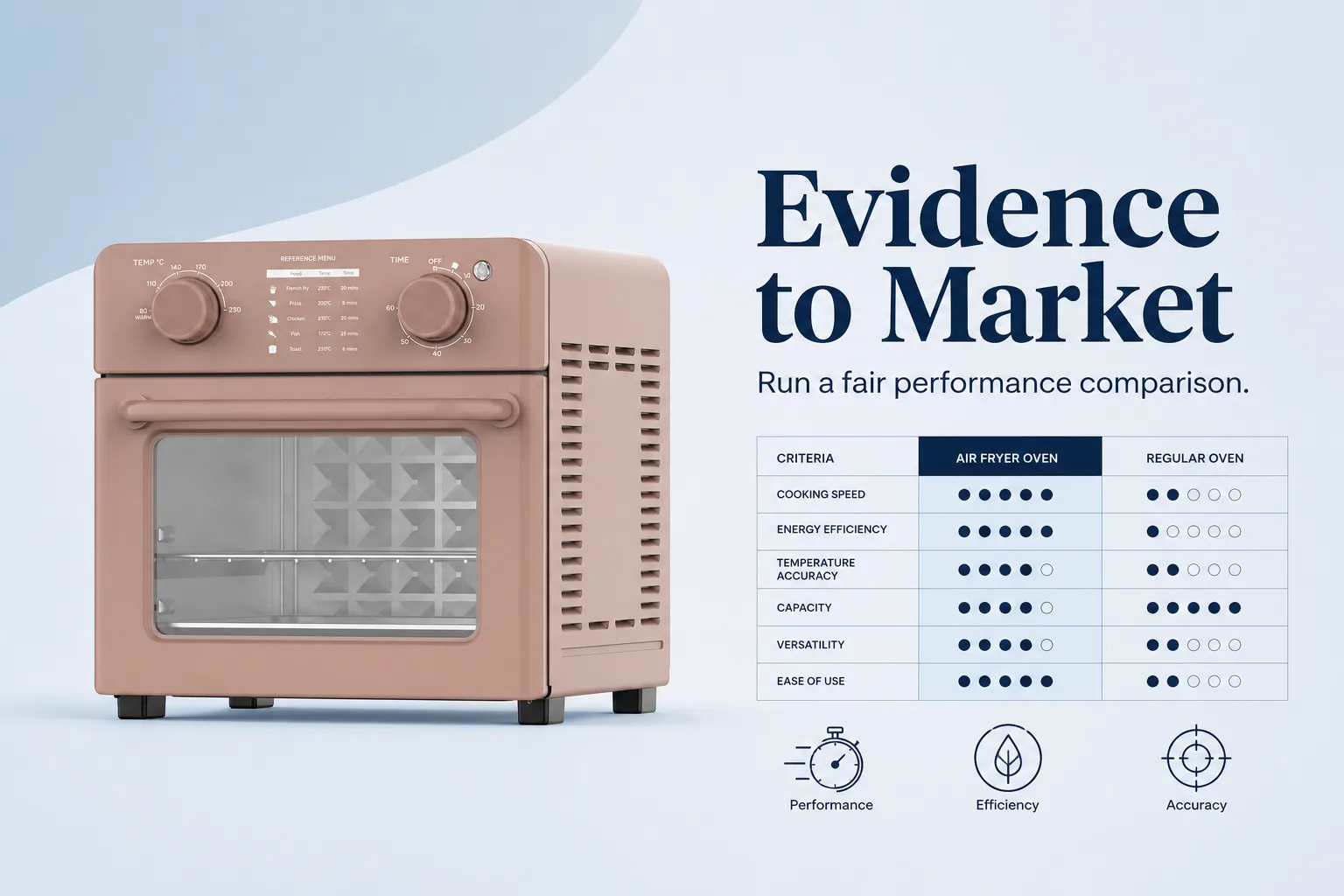
A fair comparison begins with the same food endpoint, not the same time setting. The two ovens may use different airflow, radiant exposure, trays and cavity sizes, so copying a recipe time can favour one design without answering the customer question.
What the evidence can support
Record food mass, dimensions, initial temperature, rack position, accessory, setpoint and endpoint. Measure warm-up separately from the cook cycle and report watt-hours for the full customer sequence. Use colour images or instrumental colour readings, centre temperature and mass loss where they help explain the result.
A repeatable way to compare suppliers
Test at least three representative units when the result will support a commercial decision, and use repeated runs to expose control and loading variation. Keep ambient conditions and supply voltage within the agreed range. Report noise in the operating mode used for the cooking claim, not at an unrelated low fan setting.
Cost and launch consequences
The result can guide price architecture and copy: faster for a named load, lower measured cycle energy versus a named baseline, or greater tray area. It can also reveal where the regular oven remains stronger, such as multi-tray capacity. Honest boundaries improve customer fit and reduce avoidable returns.
Boundaries on the claim
No single recipe establishes overall superiority. Do not average incompatible food results into a marketing score, and do not use rated wattage as cycle energy. Preserve the protocol so later software or accessory changes can be rechecked.
Sources and scope
The references below define measurement, safety, quality or regulatory context. They do not replace product-specific testing or legal review for the final construction and market. Accessed 7 August 2026.
- IEC 60350-1, electric cooking ranges, ovens, steam ovens and grills - methods for measuring performance: https://webstore.iec.ch/
- U.S. eCFR, 10 CFR Part 430, energy conservation program for consumer products: https://www.ecfr.gov/current/title-10/chapter-II/subchapter-D/part-430
- NIST, SI Units: https://www.nist.gov/pml/owm/si-units