
The commercial decision
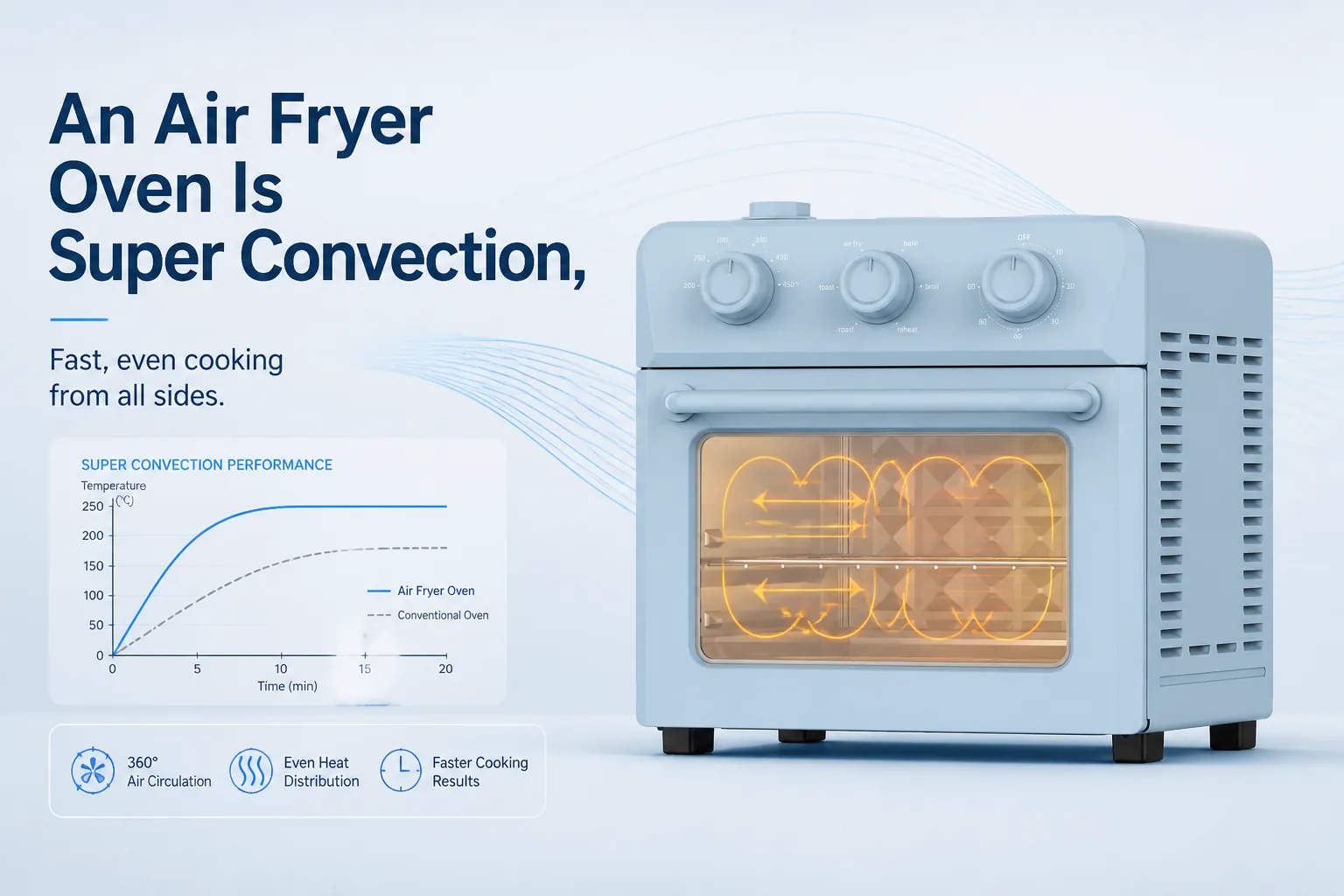
An air fryer oven cooks with heated air and radiant energy; it does not immerse food in oil. The category name describes the intended crisp result, not the heat-transfer mechanism. For buyers, the important variables are air temperature, velocity and distribution, radiant exposure, moisture removal and the food itself.
What the evidence can support
Higher air speed can thin the boundary layer around food and increase convective heat transfer, while exposed heaters add radiation. Crispness also depends on surface moisture, starch, oil film, load density and venting. A high fan rpm does not prove useful velocity at the tray, and an empty-cavity temperature trace does not prove browning uniformity.
A repeatable way to compare suppliers
Define a food protocol with mass, piece size, initial temperature, oil addition, tray loading, rack position, turn or shake steps and endpoint. Record elapsed time, mass loss and colour distribution. Use multiple tray zones and repeat units so the result exposes blocked flow, edge over-browning and batch variation.
Cost and launch consequences
Translate the test into narrow, defensible claims such as a cooking time for a named frozen product versus a named conventional-oven baseline. The engineering data can also guide basket perforation, fan control and recipe presets. Keep the protocol with the firmware revision because control changes can invalidate the result.
Boundaries on the claim
Do not describe the process as oil-free if the recipe or supplied instructions use oil, and do not imply the nutritional profile of deep-fried food without food-specific analysis. Appliance performance evidence is not a nutrition study.
Sources and scope
The references below define measurement, safety, quality or regulatory context. They do not replace product-specific testing or legal review for the final construction and market. Accessed 7 August 2026.
- IEC 60350-1, electric cooking ranges, ovens, steam ovens and grills - methods for measuring performance: https://webstore.iec.ch/
- U.S. eCFR, 10 CFR Part 430, energy conservation program for consumer products: https://www.ecfr.gov/current/title-10/chapter-II/subchapter-D/part-430
- European Union, General Product Safety Regulation (EU) 2023/988: https://eur-lex.europa.eu/eli/reg/2023/988/oj