
The commercial decision
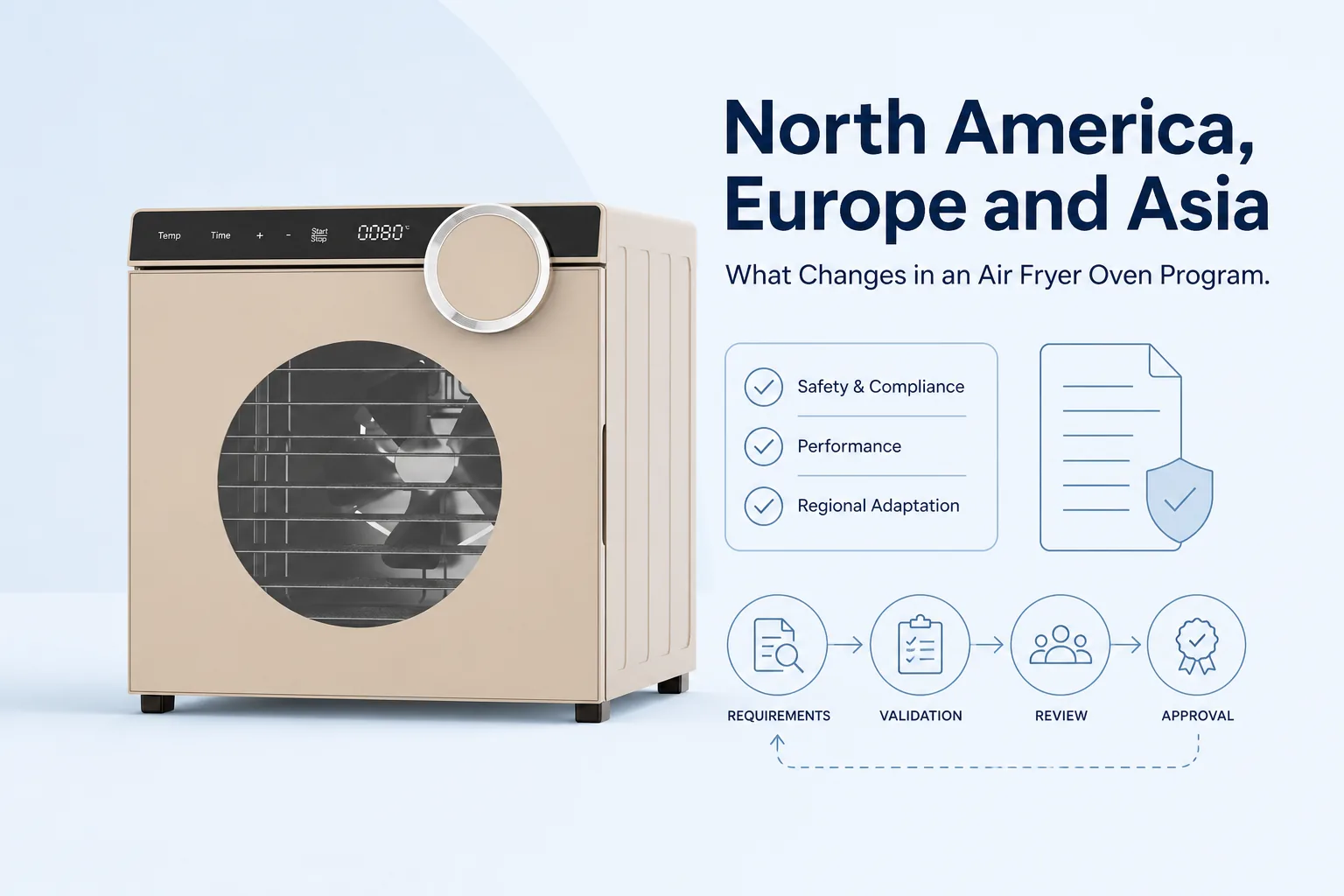
A common enclosure does not make a common market-ready product. Mains supply, plug geometry, cord rules, language, responsible-party obligations, chemical restrictions and retailer files can change the bill of materials and launch path. These decisions belong in the product brief before tooling is frozen.
What the evidence can support
Common nominal supplies include 120 V at 60 Hz in the United States, 230 V at 50 Hz across much of Europe, and 100 V with 50 Hz or 60 Hz regions in Japan. The design implication is not only the plug. For a resistive heater, power changes approximately with voltage squared when resistance is fixed, so voltage tolerance and heater selection must be reviewed together.
A repeatable way to compare suppliers
Create one market matrix covering rated voltage and frequency, plug and cord set, accessible-surface and abnormal-operation test plan, EMC route, restricted-substance evidence, labels, manual languages, importer or responsible-person data and packaging marks. Link every row to a controlled BOM revision and an owner; avoid a generic 'CE version' or 'US version' label with no configuration detail.
Cost and launch consequences
A modular platform can still work if market variants are isolated at defined interfaces: heater, motor, power board, cord entry, labels and software tables. Cost the certification samples and artwork versions as part of the program. A late regional change can trigger new testing, packaging and inventory even when the exterior looks unchanged.
Boundaries on the claim
CE marking is not a third-party certificate and it is not a universal approval for Europe. U.S. retailer requirements are not identical to federal law, and Asian markets are not one regulatory block. Use competent local compliance advice for the exact product and sales route.
Sources and scope
The references below define measurement, safety, quality or regulatory context. They do not replace product-specific testing or legal review for the final construction and market. Accessed 7 August 2026.
- IEC, World Plugs: https://www.iec.ch/world-plugs
- European Union, Low Voltage Directive 2014/35/EU: https://eur-lex.europa.eu/eli/dir/2014/35/oj
- European Union, EMC Directive 2014/30/EU: https://eur-lex.europa.eu/eli/dir/2014/30/oj
- European Union, RoHS Directive 2011/65/EU: https://eur-lex.europa.eu/eli/dir/2011/65/oj
- IEC 60335-1 and IEC 60335-2-9, household appliance safety and portable cooking appliances: https://webstore.iec.ch/