
The commercial decision
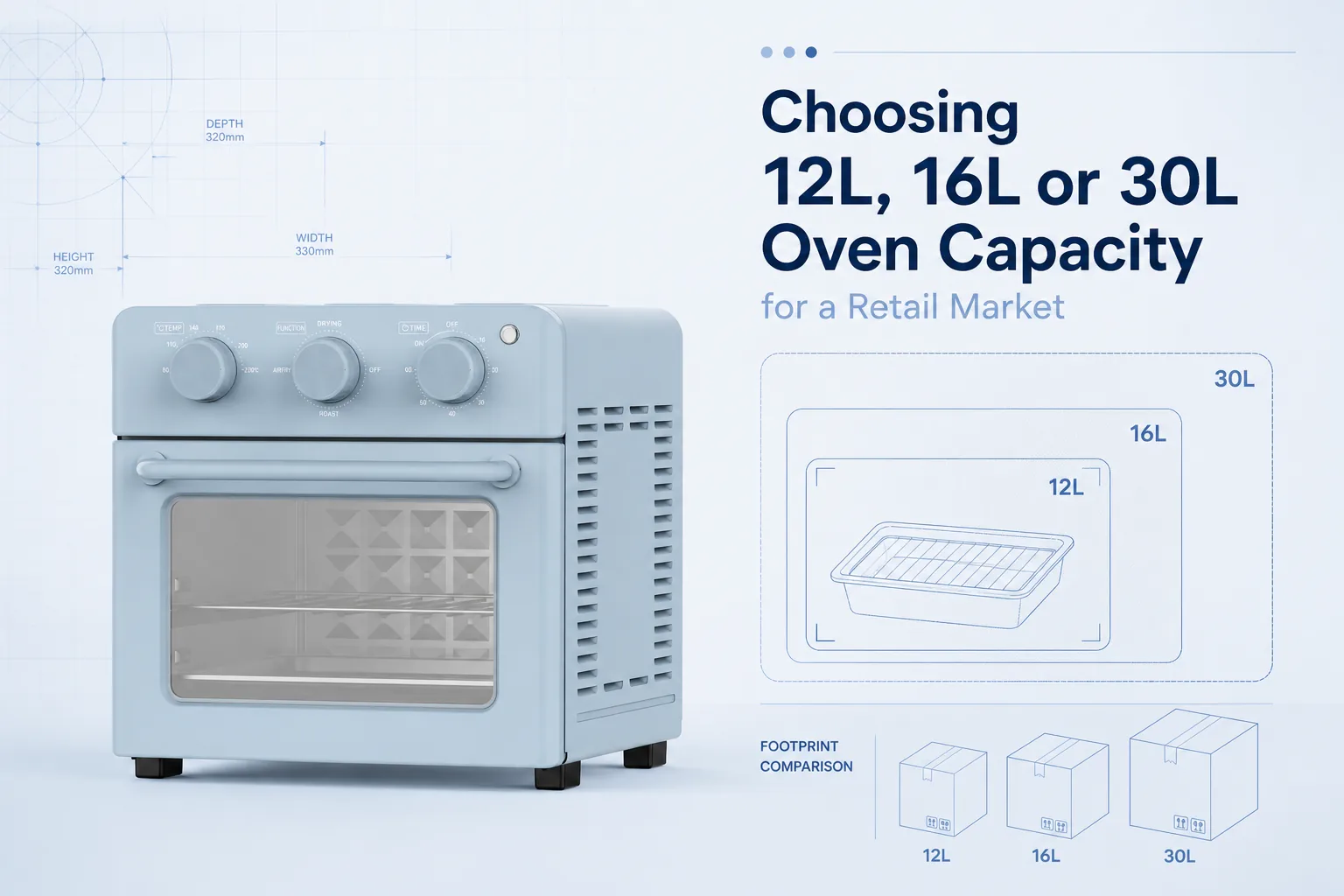
Capacity is a range decision, not a badge. A 30 L model may support a larger tray and more rack positions, but it also consumes more shelf depth, carton cube and countertop space. A compact 12 L model can be commercially stronger where parcel limits, small kitchens or entry pricing matter.
What the evidence can support
One litre is 1,000 cubic centimetres, yet rated cavity volume does not reveal the usable tray envelope. Buyers should record internal width, depth and clear height at every rack position, then repeat the measurement with the door closed and the fan guard, heater and crumb tray installed. The useful comparison is the largest food load that can be cooked to the agreed result, not an empty geometric volume.
A repeatable way to compare suppliers
Build a capacity matrix with tray dimensions, whole-chicken clearance, toast count, rack count, external footprint, door-open depth, net mass and packed carton volume. Test the same reference loads at the same supply voltage. Report warm-up time, cooking time, colour spread and the hottest and coolest food positions rather than choosing a unit after one demonstration.
Cost and launch consequences
For retail, model the landed cost per sellable function. A larger cavity may justify a higher ticket only if the target channel can display, store and deliver the carton and the customer can use the extra space. Keep 12 L, 16 L and 30 L as separate use cases in the assortment brief; do not let nominal litres substitute for customer and logistics data.
Boundaries on the claim
There is no universal best capacity and no standard conversion from litres to servings. Serving claims must be tied to a named food, load mass, accessory and cooking method. Treat any unqualified statement such as 'family size' as marketing copy until the supplier provides a measurable definition.
Sources and scope
The references below define measurement, safety, quality or regulatory context. They do not replace product-specific testing or legal review for the final construction and market. Accessed 7 August 2026.
- NIST, SI Units: https://www.nist.gov/pml/owm/si-units
- IEC 60350-1, electric cooking ranges, ovens, steam ovens and grills - methods for measuring performance: https://webstore.iec.ch/
- International Safe Transit Association, test procedures: https://ista.org/test_procedures.php